Price Per Square Foot Is a Starting Point, Not a Conclusion
Price per square foot is one of the easiest real estate numbers to compare.
Take the sale price, divide it by the home's living area, and you have a figure that appears to make one property directly comparable to another.
The calculation is useful. The problem comes when too much meaning is assigned to it.
That becomes particularly noticeable in Las Vegas luxury real estate.
Two 5,000-square-foot homes in the same community can have substantially different values even when they appear similar in a spreadsheet. One may occupy an elevated homesite with a protected Strip view. Another may sit below neighboring properties. One may have been comprehensively renovated. Another may require significant updating. One may offer exceptional privacy and outdoor living, while another has a less desirable orientation.
Price per square foot captures none of those differences by itself.
After more than 25 years in Las Vegas real estate, I use the number as one piece of the valuation process. The more distinctive the property becomes, the more important it is to understand what the number doesn't tell us.
Start With the Homesite
When evaluating a luxury property, I often begin with the land underneath it.
The house can change considerably over its lifetime. Kitchens are remodeled. Flooring is replaced. Floor plans can sometimes be reconfigured. Pools and landscaping can be redesigned.
The homesite is much harder to change.
In Las Vegas, important lot characteristics can include elevation, size, orientation, privacy, frontage, neighboring properties and views.
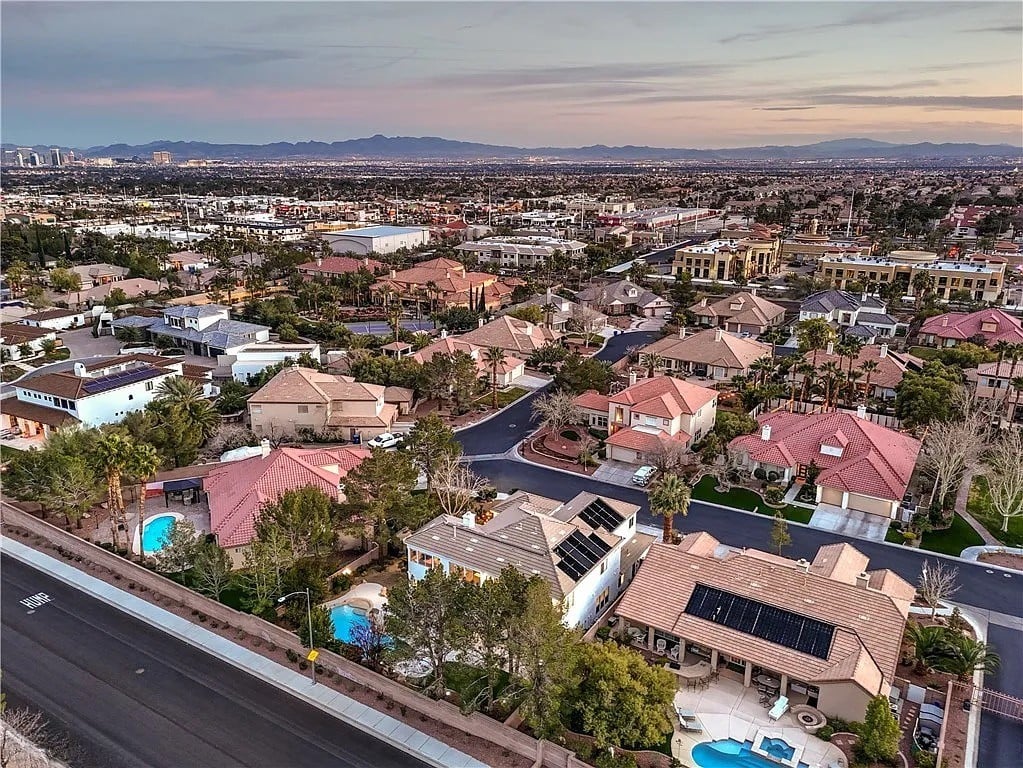
Even within the same gated community, one street may sit noticeably higher than another. A property at the edge of a community may have an entirely different outlook from an interior homesite. Two golf-course properties may have different exposure, privacy and views based on where they sit along the course.
That means the land can create a value distinction long before we consider what is inside the house.
A View Has Value, but Not Every View Is Equal
Las Vegas provides several types of views that luxury buyers seek: the Strip, Red Rock Canyon, surrounding mountains, golf courses and broad valley views.
Simply checking a "view" box on a property description doesn't tell us enough.
I want to know what the buyer actually sees and from where.
Is the view available from the primary living areas or only from an upstairs balcony? Is it framed intentionally by the architecture? Does the backyard take advantage of it? Is the view panoramic or limited to a narrow sightline?
Then there is the more important question: Can it change?
Vacant land, neighboring homesites and future development deserve attention. A spectacular view over an empty parcel can have a different long-term value from a view created by elevation or protected open space.
When buyers pay a meaningful premium for a view, understanding its durability matters.
Privacy Can Be Difficult to Quantify Until It Is Missing
Privacy is another characteristic that doesn't translate neatly into price-per-square-foot data.
A home can have an impressive backyard, pool and outdoor kitchen while being directly visible from several neighboring second stories.
Another property may be positioned so that its outdoor spaces feel remarkably secluded despite being located within the same neighborhood.
Lot width, elevation, setbacks, neighboring architecture, landscaping and the position of the home all contribute.
Luxury buyers often recognize exceptional privacy immediately when they experience it, even if they didn't identify it as a priority before beginning their search.
That is one reason the best homesites tend to remain meaningful when a property returns to the market.
Orientation Matters in the Las Vegas Climate
Lot orientation can sound like a technical detail until you experience a Las Vegas summer.
The position of the home affects sunlight throughout the day, and that can have a noticeable effect on outdoor living.
Where does the afternoon sun hit? How much shade is available around the pool and entertaining areas? Are patios covered? How does sunlight enter the primary living spaces? Does the orientation help frame a view?
A beautifully designed outdoor area that receives intense western exposure may function differently from one designed around afternoon shade.
Orientation doesn't automatically make one property good and another bad. Buyers have different preferences.
It does deserve to be considered as part of the property's overall quality rather than discovered after closing.
Architecture Has Value When It Works
Architecture is harder to quantify than square footage, which is precisely why simple comparisons can fail.
A thoughtfully designed 5,000-square-foot home can live better than a poorly planned 6,000-square-foot home.
Circulation matters. Ceiling heights matter. Natural light matters. The relationship between indoor and outdoor areas matters. So do room proportions and the placement of private versus entertaining spaces.
At the luxury level, I also consider whether the architecture takes advantage of the homesite.
If a property sits on an exceptional view lot but the primary rooms barely engage with that view, some of the land's potential has been lost.
Conversely, strong architecture can make a relatively modest difference in square footage feel irrelevant because the home uses its space exceptionally well.
More square footage doesn't automatically mean more value.
Usable Square Footage Matters More Than a Large Number
Luxury homes can include rooms that were important to a previous owner but may not be particularly useful to the next one.
Formal living spaces, oversized specialty rooms, elaborate theaters or highly customized areas can add square footage without necessarily adding proportional market value.
The question I ask is how the home actually functions.
Does it have enough bedrooms and appropriately located guest accommodations? Is there a functional office? Does the kitchen relate well to the living and entertaining areas? Is there useful storage? Does the garage accommodate the vehicles a likely buyer at this price point may own?
A floor plan should support the lifestyle associated with the property.
Buyers ultimately pay for square footage they value, not simply square footage that exists.
Construction Quality and Finish Level Need Context
Luxury listings often contain long lists of premium materials and finishes.
Those details can matter, but they need context.
Natural stone, custom cabinetry, specialty appliances, millwork and sophisticated home systems can represent meaningful quality. Their condition, execution and relevance to the current market also matter.
A costly finish installed 15 years ago shouldn't automatically be valued as though it were new. Conversely, exceptional craftsmanship or materials that would be extraordinarily expensive to reproduce today may still distinguish a property.
This is where replacement cost and market value can diverge.
A home may contain millions of dollars in improvements without buyers being willing to reimburse the seller dollar for dollar. Another property may possess architectural or construction qualities that would be difficult and extremely expensive to replicate, strengthening its market position.
Understanding that distinction is particularly important with custom homes.
Renovation Quality Matters More Than the Word "Renovated"
A renovated home can command a meaningful advantage when the work has been done well.
But "renovated" covers a wide range of outcomes.
I look at the scope and quality of the work. Were major systems addressed or primarily cosmetic finishes? Does the renovation feel cohesive throughout the home? Were materials appropriate for the property's price point? Does the updated design work with the original architecture?
Documentation can also be valuable, particularly after substantial work.
A comprehensive, professionally executed renovation can reduce the work a buyer needs to take on and reposition an older property against newer competition.
A highly personalized or poorly executed renovation may not produce the same result, regardless of what it cost.
Outdoor Living Is Part of the House in Las Vegas
When evaluating Las Vegas luxury property, I don't consider the backyard separately from the residence.
Outdoor living is too important here.
Pools, spas, covered patios, outdoor kitchens, fire features, landscaping and entertaining areas can substantially affect how a property lives.
Again, execution matters.
Is there enough covered space to use comfortably? Does the pool consume the entire yard or leave room for other activities? Does the outdoor kitchen relate naturally to the indoor kitchen? Are the landscaping and hardscape appropriate for the architecture?
An exceptional outdoor environment can be expensive and time-consuming to recreate.
For a buyer comparing a completed resale home with new construction, that replacement cost deserves particular consideration.
Garages Can Have More Influence Than Buyers Expect
Garage capacity doesn't receive the same attention as kitchens or primary suites in marketing, but it can become a meaningful differentiator at the luxury level.
Car collectors may need substantially more space than a standard garage provides. Other buyers want room for recreational vehicles, storage or equipment.
The configuration matters too.
A nominal three- or four-car garage isn't necessarily equivalent to another with the same stated capacity. Depth, ceiling height, door dimensions, storage and driveway configuration can all affect usability.
In a market where many luxury buyers have specific vehicle and storage needs, inadequate garage space can narrow the future buyer pool.
Community and Micro-Location Still Influence the Property
No luxury home exists independently of its surroundings.
The Summit Club, The Ridges, Red Rock Country Club, Ascaya, MacDonald Highlands and Southern Highlands each occupy different positions within the Las Vegas luxury market.
But even the community name doesn't complete the valuation.
A property's location within the community can create another layer of differentiation.
Distance from an entrance, traffic patterns, golf-course position, proximity to amenities, neighboring homes, elevation and street characteristics can all matter.
This is why I am cautious when someone says, "A house down the street sold for this much per square foot."
The first question is whether that house is actually comparable.
Sometimes it is.
Sometimes the two properties happen to share a street.
Scarcity Can Be More Important Than Size
One of the most useful questions when evaluating a luxury home is:
How difficult would this property be to replace?
A larger home can be built.
An interior can be renovated.
A pool can be added.
It may be impossible to recreate an elevated one-acre homesite with an unobstructed Strip view in an established guard-gated community where no comparable land remains.
Scarcity can come from the lot, architecture, location, acreage, views or a combination of attributes.
Those qualities don't always fit neatly into automated valuation models or price-per-square-foot calculations.
Buyers recognize them nonetheless.
And when enough buyers value a characteristic that cannot easily be reproduced, it can have a meaningful effect on market value.
Recent Sales Still Matter
Moving beyond price per square foot doesn't mean ignoring comparable sales.
Quite the opposite.
Recent sales provide the market evidence necessary to understand what buyers have actually been willing to pay.
The important part is interpreting them correctly.
I want to know why one property achieved more than another. Was it renovated? Did it have a better lot? Was there a superior view? Did it sell furnished? Was the architecture more current? How did its condition compare? Were market conditions different when it went under contract?
The sale price tells us what happened.
The characteristics of the property help explain why.
That distinction is what makes comparable-sale analysis useful.
The Market Determines Value, but Good Analysis Provides Context
Sellers don't determine market value by adding up what they spent on the property.
Buyers don't determine it simply by multiplying square footage by a neighborhood average.
Ultimately, value is established through the interaction between the property, competing inventory and what qualified buyers are willing to pay.
The role of good real estate analysis is to provide context for that decision.
For sellers, that means understanding which attributes genuinely strengthen the property's position before setting a price.
For buyers, it means knowing whether a premium is supported by characteristics that matter to them and are likely to remain desirable over time.
Price per square foot can help start that conversation.
It should rarely be where the analysis ends.
Evaluating a Las Vegas Luxury Property?
Timothy Low brings more than 25 years of Las Vegas real estate experience to helping buyers and sellers understand the details that influence luxury property value. Explore Timothy's Las Vegas neighborhood guides and luxury real estate resources, or connect with him for a more specific conversation about a property.